Tuesday, 20 March 2018

Project Management - Blog 5 - Project Risk Management

Image result for project risk management


Project Risk Management

Project risk management is classified as one of the most critical elements to successful project delivery. In general, projects’ scope must be delivered within the time and budget frame that were specified at the beginning. Unfortunately, those criteria are often not achieved due to poor project management process. The primary objective of project risk management is in line with the business objectives. For example, a company wants to move their IT infrastructure from on premise to the cloud. What are the risks for this process? Are users going to be affected? What KPI’s are required to be met. Will it be done on a phase approach. All these types of questions are handled under the project risk management key elements. Key performance indicators will enable the company to track the process of the project in relation to budget, quality of the project and often time taken to complete the project. Taking time to foresee the risks of moving all IT infrastructure from a company’s’ building to the cloud, does it require testing? Will the primary business be impacted should the project run into issues?
Once the project is complete, will there be requirements for change management? For example, if a virtual machine was built in the cloud to mimic the server replaced on premise, it may require additional resources and therefore this change would be required to be put to the change management board to agree the process of this change and assess the risk of changing this resource. Will it have an impact elsewhere within the infrastructure.

After the project is completed, risk management does not end and will continue to exist in additional projects, extensions to the existing project, risks that may not have existed before moving to the cloud such as high availability for example. One thing is for sure, risk management and change management will have a partnership in all types of business if a project is to be successful.

Sunday, 4 March 2018

Project Management - Blog 4 - The Art of Project Estimation


THE ART OF PROJECT ESTIMATION


Today’s blog post is in relation to estimating and how a good project manager can ensure that project estimates are precise. What is the origin of good projects failings? When designing a website, setting up a business, or building a house, in order for a project to become successful, accurate estimates are essential. Accurate estimation is every manager’s skill for good project management.

Estimating Project Times and Costs

A good foundation for every project control are quality time and cost estimates. When preparing estimates for our project, we decided the best starting point would be previous experiences to estimates, and this relates to previous projects part taken in the past. As an estimator, we have to take into consideration similar projects we have done or current resources and processes. We also rely on outside factors such as stakeholders, technology or downtimes that may affect a project. Estimating a project involves a quantitative estimate of project duration, costs, resources and is a critical part of project planning (Harned, 2014).

The key to successful estimates is to have a company’s culture that will allow us, project managers, to make an error without incrimination. To get the estimates that represent realistic average costs and times is very important, and for this reason it’s vital to dispose of a team that is highly motivated and skilled to help the project manager maintain their average in relation to task times and costs (Harned, 2014).


Top-Down vs. Bottom-Up Project Management Strategies

There are two main techniques used in estimating process: top-down and bottom-up methods. The top-down approach works well when a project manager has a big picture of the project and all project’s details are clear to everyone. The bottom-up method is used when project team members classify the tasks and then divide them into specific work packages or groups. This approach is time-consuming but more detailed than the top-down (Makar, 2015).  

Both, stakeholders and project managers want accurate estimates of time and costs. These two groups need to balance project delivery with its accuracy. Managers must bear in mind different factors of the project such as actual costs, outside influences, and know what the scope is.


The challenges of project estimation – Why good projects fail?

In general, project estimation is a tough process as it can bring a number of problems and challenges. Often people over estimate the amount of time or costs (either too optimistic or pessimistic). The lack of experience or historical information (which can be a starting point to estimation) is also a common problem. Adding in poor risk-mitigation planning, immeasurable events (such as meetings, demonstrations, holidays, prototyping, etc), unexpected events or simply unfriendly company culture and work environment all add up to why good projects fail. On occasions bad leadership or management is the primary issue, especially where management doesn’t back their team members.


Bibliography

Harned, B., 2014. THE DARK ART OF PROJECT ESTIMATION. [Online]
Available at: https://www.teamgantt.com/guide-to-project-management/how-to-estimate-projects
[Accessed 2 March 2018].

Makar, A., 2015. Top-Down vs. Bottom-Up Project Management Strategies. [Online]
Available at: https://www.liquidplanner.com/blog/how-long-is-that-going-to-take-top-down-vs-bottom-up-strategies/
[Accessed 3 March 2018].


Sunday, 25 February 2018

Project Management - Blog 3 - What is a Work Breakdown Structure (WBS)?


A Work Breakdown Structure (WBS) is a super tool as it presents a visualisation of the total scope of a project. It enables management to determine, prioritise important tasks, estimate efforts in order for the team to accomplish project goals and deliver the desired outcomes. According to The Project Management Body of Knowledge (PMBOK), a WBS ‘’is a hierarchical and incremental decomposition of the project into phases, deliverables and work packages’’ (Project Management Institute, 2018).  In a WBS, the deliverable is the end goal and it can be a thing, a service, or an activity, and that depend on our project.  


Elements 

Figure 1 Simple WBS Chart


There are many methods to partition or break down project work, the most popular is a form of visual demonstration of the project’s activities, phases, and deliverables in one single chart. The team determine project milestones, deliverables and break them further down into smaller components, called activities, required to complete the deliverable or milestone.

Typically, the WBS chart looks like a tree-structured diagram, but it can also be in the form of hierarchical tables or numbered lists. Regardless of the format, a WBS normally consist of Terminal elements (aka work packages), WBS coding and dictionary. Work packages are the lowest or smallest units of work. WBS coding includes outline numbering of WBS elements in decimal sequences to represent the sequential order of each level and activity. Finally, to complete the WBS, a related dictionary may be created. This will contain detailed information about each element of the project. The dictionary includes definitions of each work package, effort level, duration of tasks, and resources. A WBS dictionary is generally presented in a table or spreadsheet format.

Purpose
The primary goal of a WBS is to make a large project more manageable. It aids to transform project activities into less complicated tasks, so it is easier for the team to understand the scope of the project and work related. By breaking down activities into smaller chunks it means work can be done simultaneously by different team members, leading to better team productivity and overall easier project management.

Work Breakdown Structure analysis
A good way to identify the potential risks is to analyse our WBS. The team draws a diagram and questions each and every element, which eventually will give a valid list of potential risks for the project. As they are connected to the appropriate work packages this means the team will be in a better position to handle the risks.


References:

Practice Standard for Work Breakdown Structures (Second Edition), published by the Project Management InstituteISBN 1933890134, page 8


Images


Saturday, 17 February 2018

Project Management - Blog 2 - The Project Definition Phase


Providing the Groundwork for Project Planning - The Project Definition

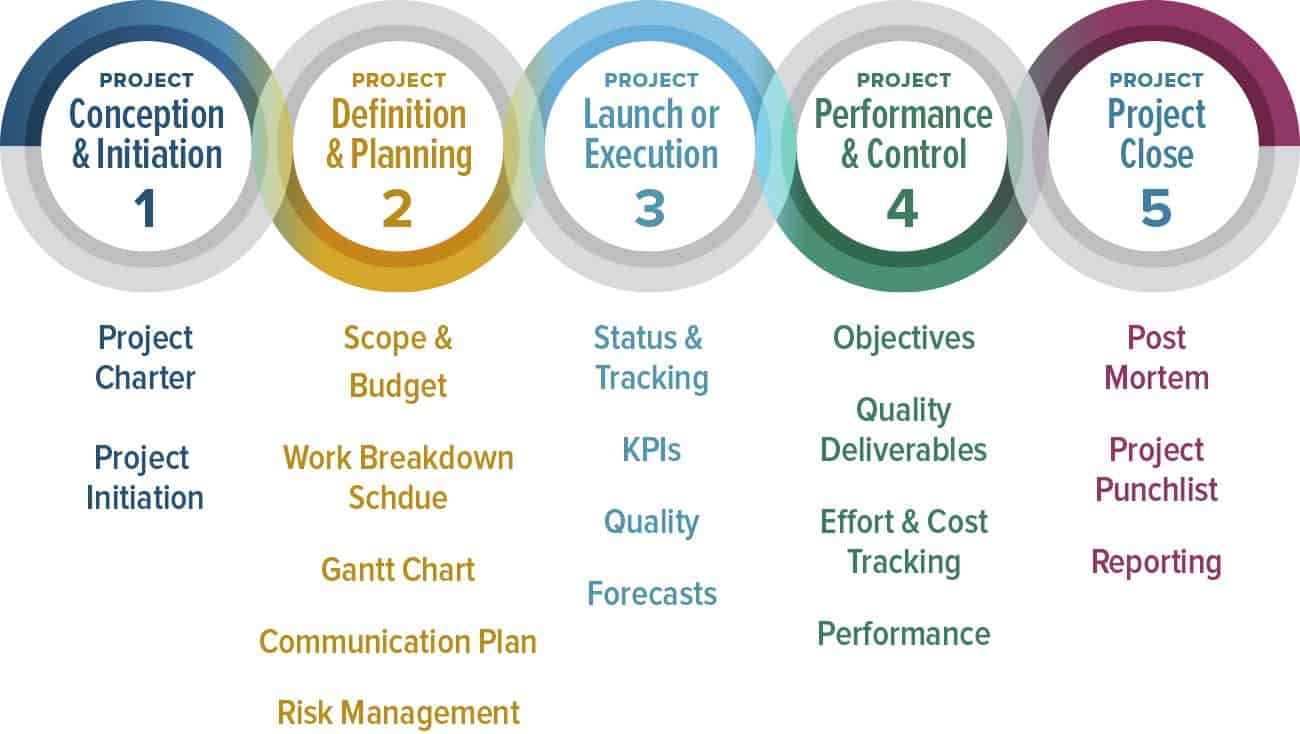
The second blog will primarily be about the phase, project definition. This will be section from the project management (PM) process that will enable the groundwork for the essential project planning. Some may say that a project has a defined end complete with a defined start and has a one-time set of activities. The Project management process is defined as the combination of knowledge, skills, techniques and tools applied together in order to meet the project requirements. There are five phases of the project management which are essentials on how to plan and accomplish project goals (Esposito, 2015).

5 Phases of Project Management

5 phases of project management


Phase 2: Project Definition & Planning

This phase plays a critical role in planning a project as it provides the roadmap for everyone to follow. This roadmap should assist in making the understanding of the project more durable. During this phase, a project plan and project scope, are defined. This definition is usually put in writing so the project management plan can be developed. The PM team will prioritize the project, identify costs, determine what resources are required, and establish a schedule in order to determine if the project in on track (Esposito, 2015).

At this stage or phase, all project team members will know their roles and what they’re accountable for in order to deliver a successful project. There is a number of documents this phase requires to create, such as:

Scope Statement -- a document outlining project’s needs, objectives, deliverables, identifying the constraints and key success factors.
WBS (Work Breakdown Schedule) – a key deliverable of visual representation of the team work divided into manageable sections.
Milestones – these are high-level goals that the team want to achieve which are represented in the Gantt Chart
Gannt Chart – provides a visual illustration of a project’s planning and scheduling of specific tasks.
Communication Plan – involves a plan for instant communication and proper messaging around the project. It is based on a deliverable and milestones.
Risk Management Plan – here we identify all foreseeable risks. Typical risks may consist of lack of finances, impossible time frames, slashing budgets, requirements forever changing or a shortfall of resources to name but a few.

All projects have risks, it is how the PM deal with the risks that will make a project stand out. Making sure they’re identified, early in the project planning is a must. Phase two provides help to PMs in identifying risks. This action aims to minimise the risk of a failure, costs associated with it, and avails to avoid unnecessary activities that reduces time and energy.

References:

Comprehensive Guide to the 5 Phases of Project Management . [Online] Available at: https://www.smartsheet.com/blog/demystifying-5-phases-project-management. [accessed 16 February 2018].

Sunday, 4 February 2018

Project Management - Blog 1 - Why Do IT Projects Fail

My initial blog post for the module Project Management consists of analysing the article, "Gartner Survey Show Why Projects Fail" by Lars Mieritz where he discusses specifically why IT projects fail concentrating on the following categories sizes, small, medium and large. Each classification is determined as per the graphic below (Mieritz 2012). 


According to Mieritz, the fundamental reasons for projects with a budget greater than $350,000 flounder are due to uncontrolled budget costs and not tracking the budget throughout the duration of the project were small IT projects, like any project for that matter, are very much straight forward to manage and accomplish on time. Below is a table created showing the percentage rate of successful IT projects and failure rates for IT projects (Mieritz 2012).


Source: Gartner (June 2012)

So why do certain classifications fail? What are the primary reasons for these failures? Is it as simple as the graphic below, small IT projects are simple and large IT projects are complex, maybe there is other factors to take into consideration on why IT projects fail.


Small Projects
Small projects have a smaller time frame for completion, therefore this type of project could be rushed, hence having poor quality or cancelled after launch as they do not meet the standards of the shareholders. But why do smaller IT projects have a higher success rate over the other two types, their iteration process is quicker, estimations of the budget can be more accurate, more time for analysis of historical data from similar small projects.

Medium Projects
Successful project management offices (PMO) tend to keep projects small in order to keep a clear criteria in regards to limiting the project size to allow for quality assurance, planning, testing. Medium IT projects tend to be greater than 6 months, therefore communication could break down, keeping stakeholders within the iteration processes is harder over lengthy time periods, therefore delivering high quality medium and large projects could prove to be more difficult and cancelled after launch.

Large Projects
Due to larger IT projects and the difficulty in gaging how long the project will take to complete is highlighted in the article of substantially late projects, with a knock-on effect of cost deviation, hence why the failure rate for Large IT projects is the highest out of the three classifications.

Anything we do, any experience, whether it is a failure, mistake, or a success, is a learning curve for the project manager and team. It is up to the PMO on how to get there, where the project meets all criteria and becomes successful. Successful projects are the ones with a great overall planning, thinking out of the box to come up with better and/or new solutions. When we enjoy what we’re doing we also become more productive and effective, engaging better with the teams. Likewise, positive attitude, good communication and creative work also count for the project success (Almakajeva 2014). 

References:
Gartner Survey Shows Why Projects Fail | thisiswhatgoodlookslike. 2018 [Online] Available at: https://thisiswhatgoodlookslike.com/2012/06/10/gartner-survey-shows-why-projects-fail/. [accessed 01 February 2018].


10 reasons why projects fail or common mistakes to avoid. 2018 [Online] Available at: https://www.slideshare.net/MariannaAlmakaieva/10-reasons-why-projects-fail-or-common-mistakes-to-avoid. [accessed 02 February 2018].


Project Management - Blog 7 - Organisational Structure

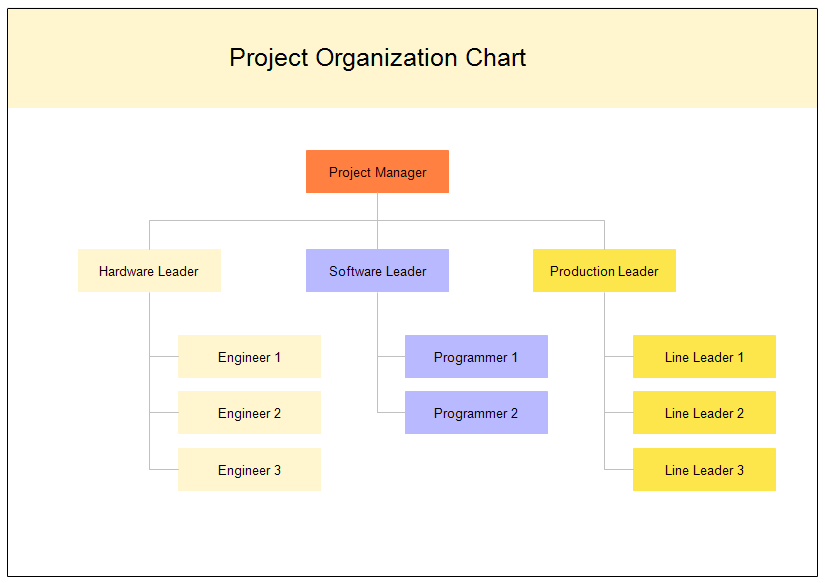
Project Management Structure Figure 1  Typical Project Organisation Chart An organisation with an excellent CEO, super h...